Grenada is a mixed economy for payments. Hotels, larger restaurants, supermarkets, car hire firms and dive shops take cards, and contactless is increasingly common in the south. But buses, markets, rum shops, roadside vendors and much of the countryside still run on cash, and many visitors are caught out when the place they want to buy from has no card machine.
The practical answer is to carry both: a card for big-ticket and tourist-facing spending, and enough EC dollars in small notes for everything else. This guide explains where each works, what extra charges to look out for, and the story of the region's digital currency experiment.
Where cards are accepted
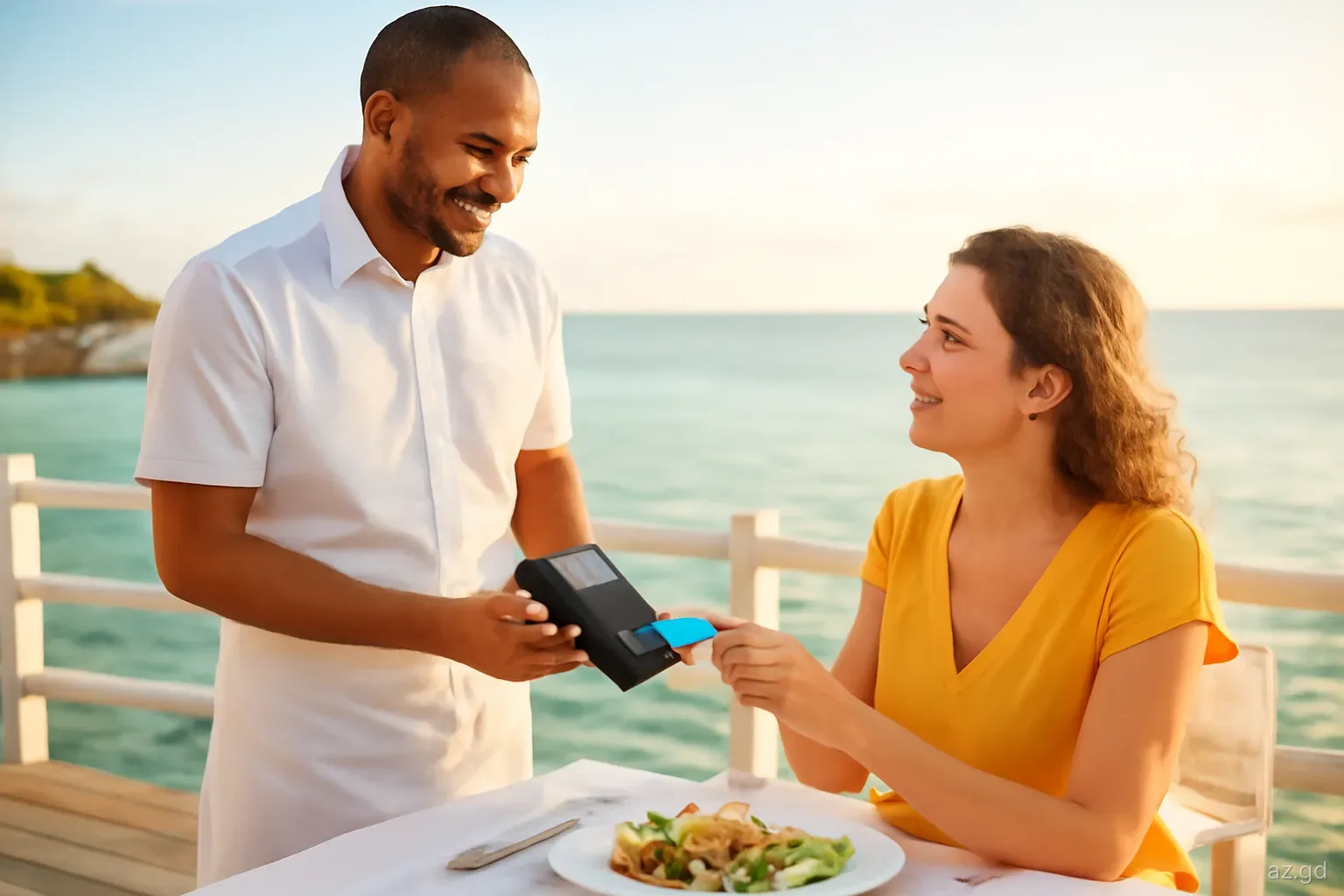
Visa and Mastercard are accepted at most hotels and guesthouses, supermarkets, restaurants aimed at visitors and residents in the Grand Anse and St George's area, car hire companies, dive and tour operators, pharmacies in town, and the larger shops and malls. Debit cards on the international networks generally work, provided they have a chip and PIN.
American Express and Discover are accepted less widely. Some hotels and higher-end restaurants take them, but many smaller businesses do not. Do not rely on them as your only card.
Card acceptance falls off quickly outside the south. Restaurants in Gouyave, Sauteurs or Grenville may be cash only, and on Carriacou and Petite Martinique many businesses do not take cards. Where a business does have a terminal, connectivity problems can make it temporarily unusable, which is another reason to carry cash.
When in doubt, ask before you order or before the driver sets off: a simple question about cards saves an awkward search for an ATM afterwards. Many businesses display card logos at the door, but a sticker is not a guarantee that the terminal is working that day.
Where cash is the only option
Route buses. Fares are paid in cash to the conductor, usually in EC dollars. Have the exact fare or small change ready.
Markets and street vendors. Market Square, Grenville market, roadside fruit stands, coconut sellers and beach vendors are cash only.
Rum shops and village shops. Many small bars and minimarts take only cash, in EC dollars.
Taxis. Most taxi drivers expect cash, in EC or US dollars. A few accept cards, but agree this before the journey.
Entrance fees and small attractions. Waterfalls, nature trails and small sites often charge a modest entrance fee, payable in cash. Some larger sites take cards.
Tips. Tips for guides, drivers and staff are given in cash.
Small guesthouses and home stays. Some smaller places ask for payment in cash or by bank transfer rather than card. Check when you book.
Contactless and phone payments
Contactless card payments and phone wallets have spread in Grenada in recent years, particularly in supermarkets, chains and modern restaurants in the south. If a terminal supports contactless, tapping a card or phone usually works for foreign visitors as long as the card issuer supports it abroad.
Not every terminal accepts phone wallets, and some businesses still insert the card and ask for a PIN. Carry your physical card even if you prefer to pay with your phone, and know your PIN; signature-only payment is uncommon.
Local banks offer online and mobile banking and transfers to their own customers, and payment apps used in North America and Europe are not generally accepted by Grenadian businesses. For visitors, contactless cards and cash cover nearly every situation.
Contactless limits apply to card payments in many places, so larger bills may still require you to insert the card and enter the PIN. Keep your card handy at the till even if you normally tap your phone.
Surcharges, conversion and other hidden costs
Some businesses add a surcharge for card payments, often a few per cent, to cover their bank fees. It should be shown or mentioned before you pay; ask if you are not sure, and consider paying cash for larger bills where the surcharge is significant.
The bigger trap is dynamic currency conversion. When a card terminal offers to charge you in US dollars, sterling or euros instead of EC dollars, it is offering its own exchange rate, which is usually poorer than the rate your card issuer would use. Always choose to pay in the local currency, EC dollars. The same applies at ATMs.
Your own bank may charge a foreign transaction fee on every card purchase. Over a week or two of paying for meals and supermarket trips by card, that can add up. A card without foreign transaction fees is worth having for travel. Car hire companies and hotels often place a pre-authorisation hold on your card as a deposit; it ties up part of your limit until released after you return the car or check out.
DCash: the digital EC dollar that paused
Grenada was one of the countries that took part in DCash, the Eastern Caribbean Central Bank's digital version of the EC dollar, launched as a pilot in 2021. DCash let users pay and transfer money through a phone app, and Grenada was one of the more active participants. It was one of the first central bank digital currencies of a currency union anywhere.
The pilot ran into technical problems, including an extended outage, and the ECCB closed it in January 2024, saying a new version would follow. In February 2026 the ECCB's Monetary Council decided to suspend development of the planned DCash 2.0 and prioritise a regional fast payment system and participation in a CARICOM payments and settlement pilot instead.
For anyone in Grenada today, that means there is no central bank digital currency in use. Watch for announcements from the ECCB about faster payments between banks in the currency union, which may change how residents pay each other in the coming years.
Paying for bigger items: car hire, villas, diving and tours
For larger purchases, a card offers protection that cash does not. Car hire companies almost always require a credit card for the security deposit, and some will not accept debit cards for the hold. Ask in advance how much will be blocked and for how long after you return the car.
Villas and apartments booked directly may ask for a deposit by bank transfer and the balance before arrival. Use a traceable method, get a written confirmation of what is included, and be cautious of anyone who insists on payment through an untraceable channel, which is a warning sign of a rental scam.
Dive shops and tour operators usually accept cards, often priced in US dollars. Ask whether a card surcharge applies; for a multi-day dive package, paying in cash may save a few per cent, but weigh that against the protection a card gives if a trip is cancelled.
How much cash to carry, and other practical tips
A balanced approach for most visitors:
- Keep enough EC dollars in small notes for a day's buses, snacks, entrance fees and tips; for many visitors that is somewhere in the range of EC$100 to EC$200, depending on plans.
- Use cards for accommodation, restaurant meals, supermarket shops, car hire and tours.
- Keep a reserve of US dollars in small notes for emergencies.
- Split cash and cards between a wallet, a bag and your accommodation safe.
- Ask before ordering whether a restaurant or taxi takes cards, especially outside the south.
- On Carriacou and Petite Martinique, rely mainly on cash.
- Keep receipts for card payments until you have checked your statement.
- Replenish cash in Grand Anse or St George's before heading north or east, where ATMs are fewer.
Frequently asked questions
Are credit cards widely accepted in Grenada?
Visa and Mastercard are accepted at most hotels, supermarkets, larger restaurants, car hire firms and tour operators, especially in the south. American Express is accepted less widely. Buses, markets, rum shops and many rural businesses are cash only, so carry EC dollars too.
Can bus fares in Grenada be paid by card?
No. Route bus fares are paid in cash to the conductor, usually in EC dollars. Carry small notes and coins. Fares are modest and depend on the distance travelled, so ask the conductor or a fellow passenger if you are unsure.
Should card payments be made in EC dollars or home currency?
Choose EC dollars. When a terminal or ATM offers to charge in your home currency, it applies its own exchange rate, which is usually worse than the rate your card issuer uses. Paying in the local currency is almost always cheaper.
Is DCash still used in Grenada?
No. The ECCB's DCash pilot ended in January 2024, and in February 2026 the Monetary Council suspended development of DCash 2.0 to focus on a regional fast payment system instead. There is currently no digital EC dollar in use.
Do Grenadian businesses charge extra for card payments?
Some do, typically a small percentage to cover bank fees. It should be disclosed before payment. If you see an unexpected surcharge, ask about it, and consider paying cash for larger bills where it would make a meaningful difference.
Does Apple Pay or Google Pay work in Grenada?
Phone wallets work at many contactless terminals in supermarkets, chains and modern restaurants, mostly in the south. Not every terminal supports them, so carry your physical card and know your PIN as a backup, along with some cash.