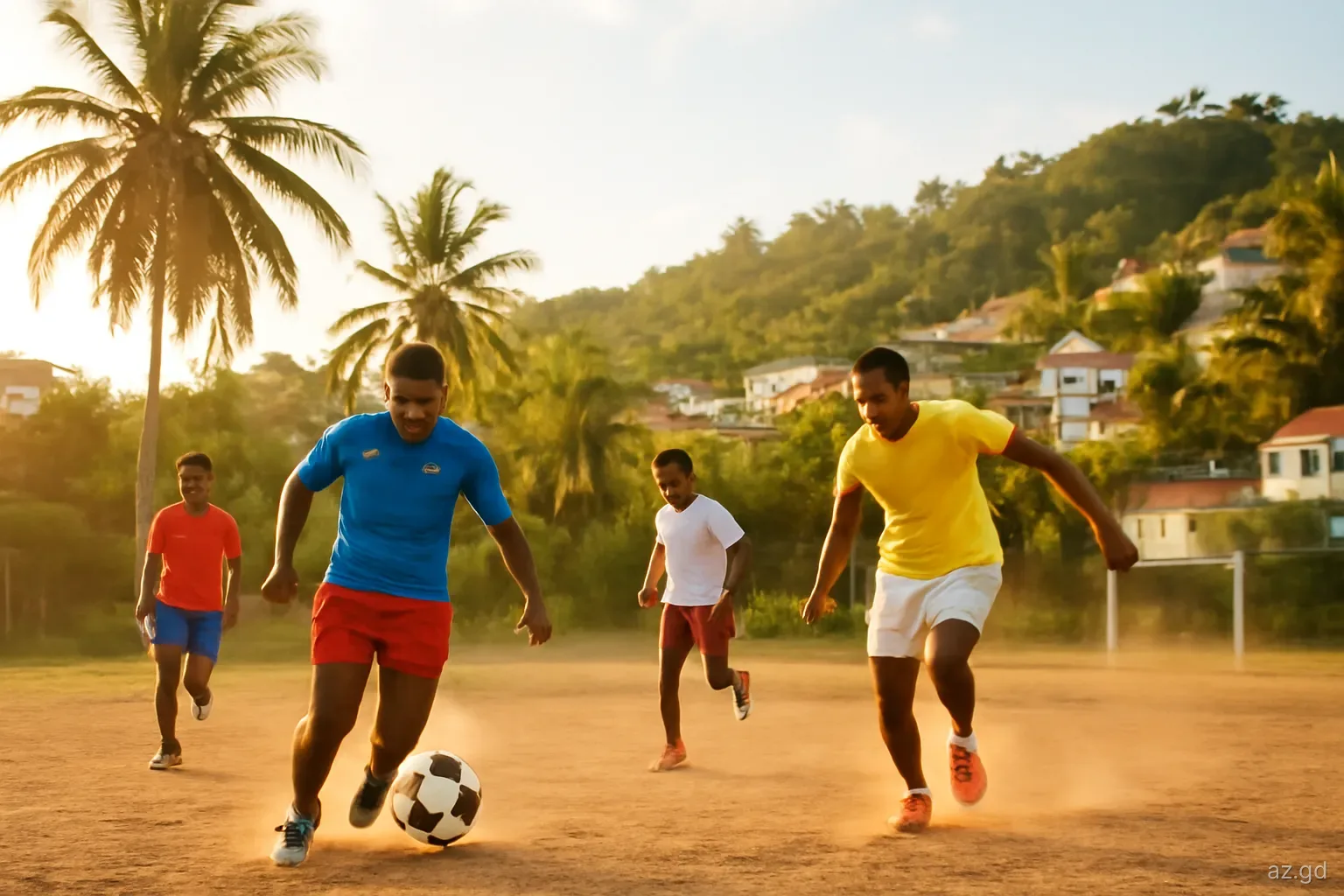
Cricket gets the history books and athletics gets the medals, but on any given evening across Grenada more people are playing football than either. Village pitches fill up after work, schoolboy matches draw noisy crowds, and the national team, known as the Spice Boys, has punched above its weight in the region, reaching the CONCACAF Gold Cup three times.
This guide explains how Grenadian football is organised, the national team's high points, where matches are played and how visitors and new residents can watch or join in.
The Spice Boys: high points and hard nights
The Grenada Football Association, founded in 1924, runs the national teams and joined CONCACAF in 1969 and FIFA in 1978. The men's team plays home matches at the Kirani James Athletic Stadium in St George's.
The best era came around 2008 to 2011. Grenada reached the final of the 2008 Caribbean Cup, losing 2-0 to hosts Jamaica, having also been runners-up in 1989. That run brought qualification for the 2009 Gold Cup, followed by another appearance in 2011, and the team climbed to its highest FIFA ranking, 88th, in July 2009. A third Gold Cup appearance followed in 2021. Each time the team went out in the group stage against stronger, better-funded opponents, but simply qualifying was a major achievement for a nation of Grenada's size.
There have been hard nights too, including heavy defeats against stronger regional sides. Today the Spice Boys compete in the CONCACAF Nations League, where they have moved between Leagues A and B, and in World Cup qualifying.
How local football is organised
Club competitions. The GFA runs a national league structure with a Premier Division at the top and lower divisions below, plus cup competitions. Clubs are rooted in communities and parishes, and local rivalries are fierce.
Seasons vary. Fixtures depend on weather, pitch availability and funding, so league seasons do not always run to a fixed calendar. Check the GFA's announcements and local sports radio.
Schools football. Secondary schools football is one of the most watched sporting events in Grenada, with packed grounds for finals and strong loyalty to old schools.
Women's football. Women's and girls' football has grown, with national teams competing regionally. The Kirani James Athletic Stadium hosted matches at the 2016 CONCACAF Women's Under-17 Championship.
Carriacou and Petite Martinique. The sister islands have their own competitions and community teams, and travelling sides crossing on the ferry for matches is part of island life.
Where to watch
International matches are played at the Kirani James Athletic Stadium. Ticket prices for Nations League and World Cup qualifiers are usually modest compared with North America or Europe, and tickets are sold at the stadium and through outlets named by the GFA before each fixture. Big games draw lively crowds, music and food vendors outside the gates.
Club and schools football is often played on community grounds and parish playing fields across the island. These matches are informal: you may stand along the touchline or sit on a bank above the pitch, and there may be no ticket at all. Evening matches under lights, where floodlights exist, are especially popular.
International football from Europe is also hugely popular, and many bars and rum shops show Premier League and Champions League matches. Expect strong opinions about Manchester United, Arsenal, Liverpool, Barcelona and Real Madrid.
Local radio stations carry commentary and discussion of national team matches, and sports call-in programmes are a good way to follow the domestic game and pick up news of fixtures that may not be well publicised elsewhere. For away internationals, the national team's matches are often streamed or shown in bars around St George's and Grenville.
Joining a game as a visitor or new resident
Grenadians are generally welcoming to newcomers who want to play, provided you respect local customs. These tips help.
- Ask at your local community playing field or village ground. Evening pick-up games are common, especially on weekdays after work.
- Bring water and wear proper boots; many community pitches are hard, uneven and dusty in the dry season and muddy in the rainy season.
- Respect the regulars. Watch a game first, ask who organises it, and wait to be invited in.
- For organised football, contact a local club through community networks or the GFA. Clubs sometimes welcome experienced players, coaches and volunteers.
- Students at St George's University often organise their own football and five-a-side games, which are open to newcomers.
- Play early or late to avoid midday heat. Football in the tropical sun requires serious hydration.
- Bring a spare ball if you can. Good footballs are relatively expensive locally, and a donated ball is a welcome gesture at a community ground.
From schoolyard to national team
Most Grenadian footballers start in primary school, kicking a ball on any flat ground available. Promising players move on to secondary school teams, where inter-school competitions are often their first experience of a crowd. From there, the strongest join community clubs in the GFA leagues and are selected for national youth squads at under-15, under-17 and under-20 level.
Youth squads compete in CONCACAF tournaments, which give scouts and university coaches a chance to see Grenadian players. A number go on to college football in the United States, and a few have played professionally in the region or beyond. The GFA's technical programmes, supported by FIFA and CONCACAF development funding, train coaches and referees and organise grassroots festivals for young children.
Parents of talented children should ask about GFA youth programmes and local club academies. Volunteering as a coach, referee or administrator is also welcome: small federations depend heavily on volunteers to keep competitions running.
Challenges facing Grenadian football
Grenadian football faces the same constraints as most small Caribbean nations. Funding is limited, pitches are often in poor condition, and the best players leave for opportunities abroad, in the United States, England or elsewhere in the Caribbean, where coaching and professional contracts are better.
The GFA has invested in youth development and coaching courses with CONCACAF and FIFA support, and grassroots programmes reach many schools. But turning local enthusiasm into sustained international success requires money, facilities and organisation that small federations struggle to provide.
Hurricanes add another layer of difficulty. Storms damage pitches, stands and equipment, and recovery can take years, as Carriacou and Petite Martinique experienced after Hurricane Beryl in 2024.
Despite this, the game's popularity is not in doubt. Every new generation of schoolboys and schoolgirls fills the village pitches, and the dream of following the Gold Cup players into the national team, or of earning a scholarship abroad, keeps grassroots football alive.
What to know before you go to a match
Arrive early for international matches, both to secure a good seat and to enjoy the atmosphere outside the stadium. Bring cash for tickets, food and drinks, and expect security checks at the gates.
Dress for the heat, with a hat and sunscreen for daytime matches, and expect noise: drums, conch shells, horns and singing are all part of the experience. At community matches, be aware that crowds can stand close to the touchline, and keep children back from the play.
Finally, enjoy the conversation. Football fans in Grenada love to talk about the game, and a question about the Spice Boys or the local league can start a long and friendly discussion.
If you take photographs, be considerate. Ask before photographing children or players up close, especially at community and schools matches where families are present.
Frequently asked questions
What is the Grenada national football team called?
The Grenada men's national team is known as the Spice Boys, a nod to the island's reputation as the Spice Isle. The team is run by the Grenada Football Association and plays home matches at the Kirani James Athletic Stadium in St George's.
Has Grenada ever played in the Gold Cup?
Yes. Grenada has qualified for the CONCACAF Gold Cup three times, in 2009, 2011 and 2021, going out in the group stage each time. Qualification for 2009 followed the team's run to the 2008 Caribbean Cup final, where they lost to Jamaica.
Where does Grenada play home football matches?
The national team plays at the Kirani James Athletic Stadium in St George's, a multi-purpose stadium holding around 8,000 spectators. Club and schools football is played on community grounds and parish playing fields around Grenada, Carriacou and Petite Martinique.
Can visitors join a football game in Grenada?
Often, yes. Evening pick-up games on community pitches are common, and regulars usually welcome newcomers who ask politely and play fairly. Bring water and suitable boots, and watch a game first to understand how the local group organises itself.
When is the football season in Grenada?
The GFA's club competitions do not always follow a fixed calendar, as fixtures depend on weather, pitch availability and funding. Check the Grenada Football Association's announcements and local sports radio for current league and cup schedules.