In Grenada, the number to remember is 911. It reaches the Royal Grenada Police Force and the fire service, and call-takers can connect you to ambulance and other help. That single number works from any mobile phone on the local networks and from landlines, on the mainland and on Carriacou and Petite Martinique.
Knowing the number is only half the job. Emergency services in Grenada are organised differently from those in North America or Europe: ambulances are attached to hospitals, the fire service is part of the police, and many addresses are described by landmarks rather than street numbers. Understanding those differences helps you get the right help, faster.
Who answers and what each service does
Police. The Royal Grenada Police Force (RGPF) is the national police service, with headquarters at Fort George in St George's and stations in every parish and on Carriacou and Petite Martinique. Call 911 for crimes in progress, road accidents with injuries, threats to safety and any situation where you are unsure who to call.
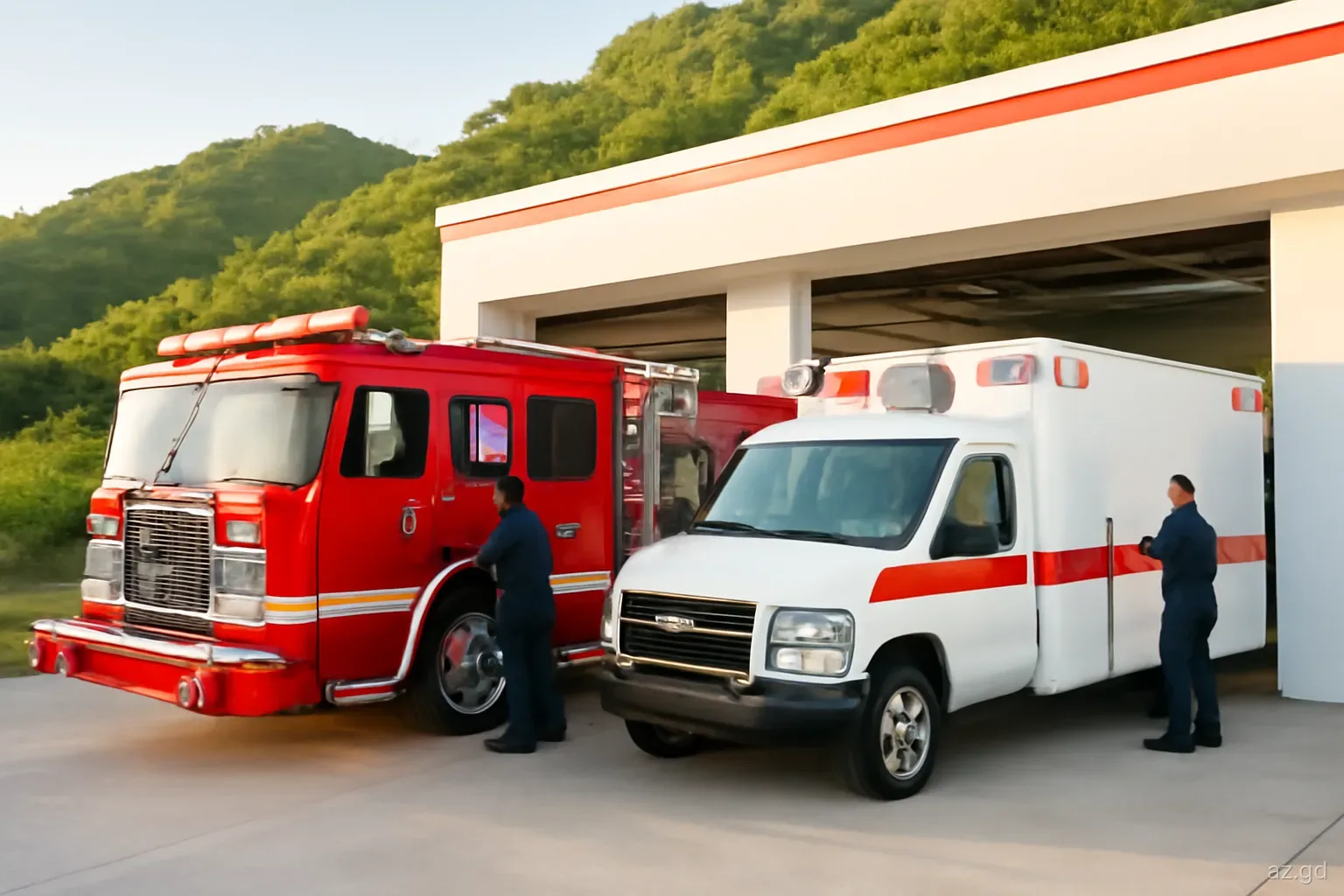
Fire. The fire service operates as a department of the RGPF, with stations around the island. Firefighters attend building and vehicle fires, bush fires during the dry season, and rescue situations such as people trapped after road accidents.
Ambulance. Ambulances are run from the three general hospitals: the General Hospital in St George's, Princess Alice Hospital near Grenville and Princess Royal Hospital on Carriacou. The government publishes short direct numbers for each ambulance service; save them from the official emergency services list when you arrive, but 911 will also get you help.
Coast Guard. The Royal Grenada Coast Guard, a unit of the RGPF based at True Blue, handles search and rescue at sea. Boaters should use VHF channel 16 for distress calls; on land, 911 can relay a sea emergency.
Disaster management. The National Disaster Management Agency (NaDMA) coordinates the national response to hurricanes, floods, earthquakes and volcanic alerts at Kick 'em Jenny, and issues official public advisories.
What to say when you call 911
Call-takers will ask questions in a set order. Stay on the line, speak clearly and let them lead, but have these points ready:
- What has happened, in one sentence: a road accident with two injured, a house fire, a person collapsed and not breathing.
- Where you are, as precisely as possible. Give the parish, village or area, the road, and a landmark: a church, school, rum shop, petrol station, bus stop or the name of the hotel or villa.
- How many people are hurt and whether anyone is unconscious, not breathing or bleeding heavily.
- Any immediate danger, such as fire, fuel leaking, live electricity lines, rising water or an aggressive person.
- A phone number where you can be called back. If you are using a foreign SIM card, say so.
- Then follow instructions. Call-takers can talk you through basic first aid while help is on the way.
Giving a location that responders can find
Many homes and villas in Grenada do not have a street number, and some roads have no official name in daily use. People navigate by landmarks and community names, and responders do too. A description such as "Morne Jaloux, the road above the school, second house after the blue church, white wall and black gate" is far more useful than a postcode-style address or a name a map app has invented.
Visitors should learn their accommodation's location in this way on the first day. Ask the owner or hotel how they would describe it to an ambulance driver and write that down. If you are hiking or at a remote beach, note the nearest village or junction. GPS coordinates from your phone can help, especially for the coast guard, but always give a landmark description too.
At night, send someone to the roadside to wave down the ambulance or fire engine, switch on outside lights, and open gates. Those minutes matter where house numbering does not exist.
Response times and realistic expectations
Grenada is small, but its roads are narrow, winding and often congested around St George's at peak times. Ambulances are stationed at hospitals rather than across the island, so a call from St Patrick in the far north, the hills of St John or a remote part of St David can take noticeably longer to reach than one from Grand Anse. Fire engines face similar constraints on steep, narrow lanes.
For that reason, people in rural areas sometimes take an injured but stable person to hospital themselves, and community members often help with transport. That is a judgement call. If someone has chest pain, may have a spinal injury, is unconscious or is bleeding heavily, call 911 and follow the call-taker's guidance rather than moving them.
On Carriacou and Petite Martinique, emergency services are smaller and serious medical cases may need transfer to the mainland by air or sea, which depends on weather and daylight.
While you wait for help
Someone not breathing. If a person is unresponsive and not breathing normally, start chest compressions in the centre of the chest, hard and fast, and keep going until help arrives or someone trained takes over. The 911 call-taker can coach you. Many hotels, dive shops and marinas have staff trained in first aid; shout for them.
Heavy bleeding. Press firmly on the wound with a clean cloth and keep pressing. Do not keep lifting it to check. Raise the limb if possible.
Unconscious but breathing. Roll the person onto their side into the recovery position so the airway stays clear, unless you suspect a neck or back injury, and watch their breathing.
Road accidents. Switch on hazard lights, warn oncoming traffic around bends, and keep people out of the road. Do not move the vehicles until the police have attended, unless they are blocking a dangerous spot or there is a fire risk.
Fires. Get everyone out, close doors behind you if it is safe to do so, and do not go back inside. In bush fires, move upwind and away from the fire's path.
Non-emergency help and who else to call
Not every urgent problem needs 911. For a crime that has already happened and where nobody is in danger, such as a theft discovered in the morning, go to the nearest police station to report it. For fallen power lines, stay well away and report them to GRENLEC, the electricity company, as well as to the police if they are on a road. Burst water mains and supply problems go to NAWASA, the water authority.
During hurricanes, floods or volcanic alerts, NaDMA's public advisories, broadcast on local radio and television and posted on official channels, are the authoritative source. The Grenada Red Cross Society supports communities in disasters and runs first aid training. For a stranded or broken-down vehicle, the car hire company is the first call. Keeping these distinctions in mind keeps the emergency lines free for genuine emergencies.
Numbers and details to save before you need them
A few minutes on arrival saves panic later, especially because phones run out of battery and signal can be patchy in the hills and on the sister islands. Store these in your phone and on a card in your wallet or on your boat:
- The 911 emergency number and the ambulance numbers for the nearest hospital, from the official government list.
- Your accommodation's full landmark description and the owner or manager's contact details.
- Your travel insurer's 24-hour assistance number and your policy number.
- The contact details of your embassy, high commission or consulate covering Grenada.
- The nearest police station to where you are staying.
- For boaters, the coast guard contact and the VHF working channels used by your marina.
- A local contact, such as a guide, landlord or colleague, who knows the area and can help direct responders.
Frequently asked questions
What is the emergency number in Grenada?
The emergency number in Grenada is 911. It connects to the police and fire service, and call-takers can arrange ambulance help. It works from local mobile networks and landlines on the mainland, Carriacou and Petite Martinique. The government also lists direct ambulance numbers for each hospital.
Does 112 work in Grenada?
Grenada uses 911 as its emergency number. Some international mobile phones redirect 112 to the local emergency number, but this should not be relied on. Save 911 and the hospital ambulance numbers from the official list to be sure you can reach help.
How do you call an ambulance in Grenada?
Call 911 or the direct ambulance number for the nearest general hospital, which the Government of Grenada publishes. Give a clear landmark-based location. In remote areas, ambulances can take time to arrive because they are based at the hospitals in St George's, near Grenville and on Carriacou.
Who handles sea rescues in Grenada?
The Royal Grenada Coast Guard, a unit of the Royal Grenada Police Force based at True Blue, handles search and rescue. Boaters should make distress calls on VHF channel 16. From land, call 911 and say the emergency is at sea.
Is the fire service in Grenada part of the police?
Yes. The fire service operates as a department of the Royal Grenada Police Force. Firefighters respond to building, vehicle and bush fires and to rescue incidents. Call 911 to report a fire anywhere in Grenada, Carriacou or Petite Martinique.