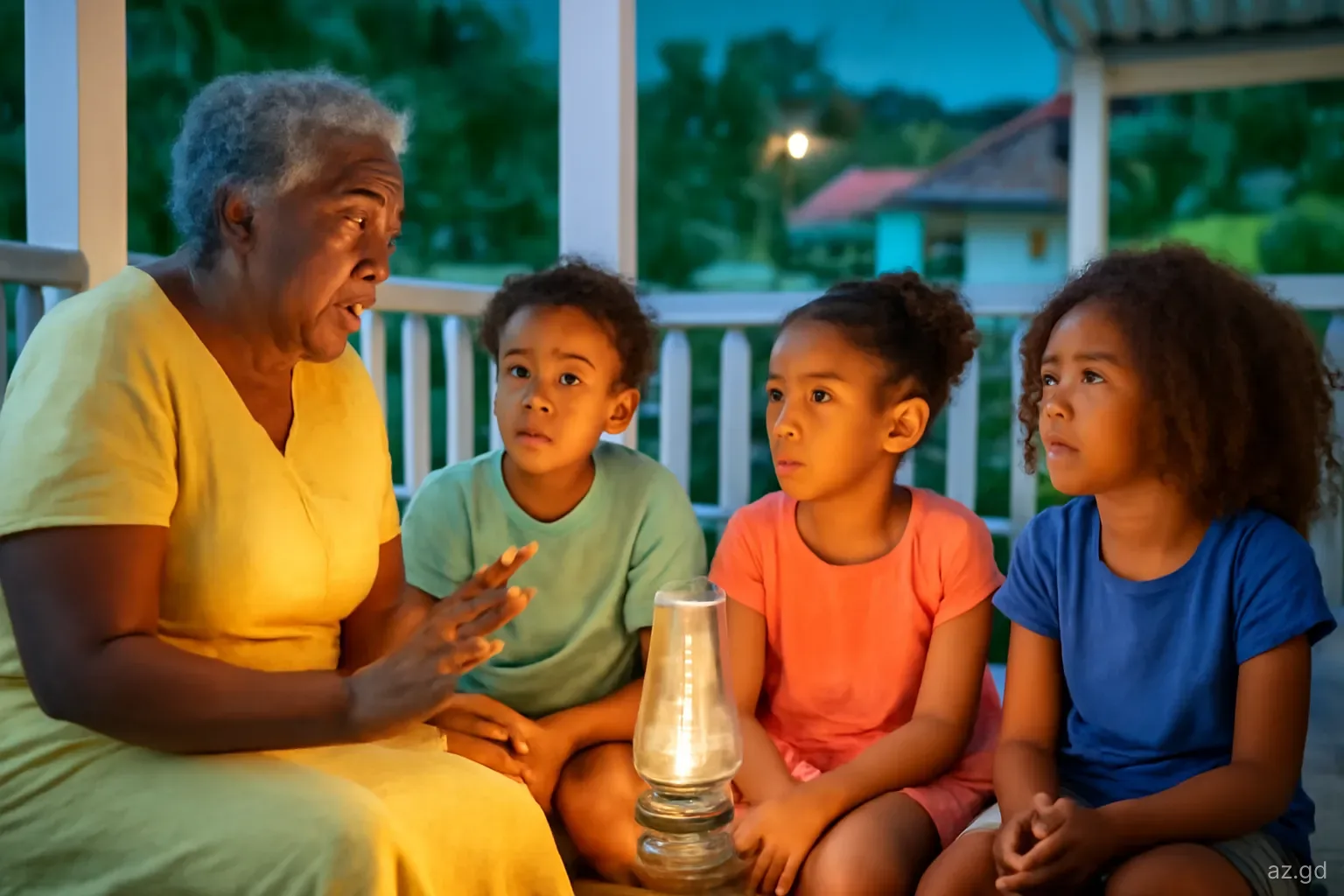
English is Grenada's official language, used in schools, courts, Parliament and the newspapers. On the street you will hear something else: Grenadian Creole English, fast, musical and full of words that never appear in a British dictionary. Underneath that lies an older layer, the French-based Patois that most Grenadians spoke well into the nineteenth century and that a dwindling number of older people still remember.
That French layer is why a mostly English-speaking island has a map covered with names like Gouyave, Sauteurs, Grand Etang and Lance aux Epines, and why its night-time stories feature a cast of creatures with French names. This guide explains the languages, decodes the place names, and introduces the folklore that still turns up in everyday speech.
Three layers of language
Grenadian Creole English developed from the English of planters, soldiers and officials, reshaped by the grammar and sounds of African languages and French Creole. It has its own patterns: dropping the verb to be in places (she real nice), using go or going for the future, and marking plurals with dem (the children dem). It ranges from light Grenadian English, used in shops and offices, to deep Creole that newcomers struggle to follow. Most Grenadians move between the two depending on who they are talking to.
Grenadian French Creole, usually called Patois, was the everyday language of most of the population after more than a century of French rule and settlement. Under British rule English slowly replaced it, a process accelerated by schooling, the churches and migration. By the late twentieth century only older people in some rural communities used it regularly, and today it is considered endangered. It is closely related to the Kwéyòl still widely spoken in St Lucia and Dominica, so a St Lucian visitor can often understand what older Grenadians remember.
Standard English is the language of formal writing and official business. Spelling follows British conventions, though American influence through television and family abroad is everywhere. Creole is increasingly heard on radio call-in programmes, in calypso and soca lyrics and in local comedy and theatre, and writers and teachers in Grenada have argued for valuing it in school rather than simply correcting it. CXC examinations, however, are written and marked in Standard English.
Decoding French place names
Sauteurs. French for jumpers or leapers, recalling the Kalinago who are said to have leapt from the cliff there around 1650.
Gouyave. Usually linked to the French word for the guava tree. The British renamed the town Charlotte Town, but the old name won and is what everyone uses.
Grand Etang. Great pond, after the crater lake at the heart of the forest reserve.
Lance aux Epines. Roughly cove of thorns, the peninsula on the south coast. Locals pronounce it close to lance-oh-peen.
Morne. A Creole word for hill or mountain, used in names such as Morne Rouge, Morne Jaloux and Morne Fendue.
Grand Anse. Big cove. The word anse, cove, appears all over the islands, from Anse La Roche on Carriacou to smaller bays along the leeward coast.
Petite Martinique. Little Martinique, named by the French after the larger island to the north. Its people are known for seafaring and boatbuilding.
Pronunciation traps
Visitors often say place names the French way or the English way and get both wrong. Grenada itself is pronounced gren-AY-da, not like the Spanish city. Gouyave sounds close to gwahv, Sauteurs is closer to so-TUR, and Calivigny is cal-ee-VIN-ee. Grenville is pronounced the English way, and its older French name, La Baye, survives mainly in history books and in the name of the surrounding district.
Carriacou is CARRY-a-coo, stressed on the first syllable. In St George's, the harbour area is the Carenage, said in the English way. If unsure, ask: Grenadians are generally happy to help with pronunciation, and getting a name right in a bus or a shop is quietly appreciated.
Directions add another layer. Grenadians often give directions by landmarks rather than street names, and use local names for areas that do not appear on official maps. A place may be known by the old estate name, a church or a shop that closed years ago. When a bus conductor calls a stop by a name you do not recognise, it is worth asking rather than guessing.
Folklore characters you will hear about
Ligaroo. From the French loup-garou, but in Grenada a person, usually a man, who sheds his skin at night and flies as a ball of fire to suck the blood of sleepers. Salt on the discarded skin is said to stop him returning to it.
Lajables. From la diablesse, the she-devil: a beautiful woman in a long dress and wide hat who lures men away at night, hiding a cow's hoof under her skirt. Men who follow her end up lost in the bush or worse.
Soucouyant. A female counterpart to the ligaroo, often imagined as an old woman by day. Bruises on waking were once blamed on her visits.
Mama Glo. From maman de l'eau, the mother of the water: a spirit of rivers and the sea, half woman and half fish or snake, who protects water and punishes those who misuse it.
Maljo. Not a creature but the evil eye, from mal yeux. Admiring a baby or a plant too much is said to give it maljo, and some families still tie a protective charm or say a quick blessing.
Patois words that survive in everyday Creole
Bazodee. Confused or dazed, a word shared with Trinidad and St Lucia.
Tanty. Aunt, but also any older woman you respect, from the French tante.
Zandoli. The small green or brown lizard found on every veranda, from a French Creole word.
Bon Dieu. Good God, used as an exclamation, often run together as bondjé.
Ti. Little, from petit, used in nicknames and some names of plants and fish.
Jab Jab. The devil mas of carnival, from diable, devil. The masqueraders' name keeps a French word alive in the biggest festival of the year.
Lambi. Conch, from French Creole, eaten curried or stewed. Fishermen still use many Creole names for fish and shellfish that do not appear in English guides.
Maco. A nosy person who minds other people's business, from French Creole. To maco is to snoop, and every village is said to have its champion.
Dou-dou. Sweetheart or darling, from the French doux, used for lovers, children and sometimes, teasingly, for friends.
Etiquette and mistakes around language
A few habits make conversations easier and avoid offence:
- Greet first. Say good morning, good afternoon or good night before asking anything, in shops, on buses and at offices. Launching straight into a question is considered rude.
- Don't call Creole broken English. It is a language with its own rules, and many Grenadians are sensitive to it being mocked.
- Don't imitate the accent. It rarely comes across as friendly.
- Learn a few local words. Lime (to hang out), fig (green banana), provision (root vegetables), steups (the sucking of teeth to show irritation) and ent (isn't it) will come up constantly.
- Take folklore with good humour. Many people tell ligaroo stories with a smile, but for some older Grenadians these beliefs are serious. Don't mock them.
Frequently asked questions
What language is spoken in Grenada?
English is the official language and is used in schools, government and media. In daily life most people speak Grenadian Creole English. A small and shrinking number of older people also speak Grenadian French Creole, known as Patois.
Is French still spoken in Grenada?
Standard French is not, apart from in schools as a foreign language. The French-based Patois survives only among some older people, mostly in rural areas, and is considered endangered. It is close to the Kwéyòl of St Lucia and Dominica.
How do you pronounce Grenada?
Gren-AY-da, with the stress on the second syllable. It is not pronounced like Granada in Spain. Carriacou is CARRY-a-coo, and Gouyave is close to gwahv.
What is a ligaroo?
A figure from Grenadian folklore: a person who sheds their skin at night and flies as a ball of fire to suck people's blood. The name comes from the French loup-garou, though the Grenadian creature is quite different from a werewolf.
Why does Grenada have French place names if it was British?
The French controlled Grenada for over a century before Britain and named most of the landscape. The British renamed towns and parishes, but rivers, hills, bays and estates largely kept their French names, and some British renamings never caught on.
What does 'lime' mean in Grenada?
To lime is to hang out with friends, usually relaxed and unplanned, often with food, drink and music. A lime can be on a beach, outside a rum shop or in someone's yard. The word is used across the southern Caribbean.