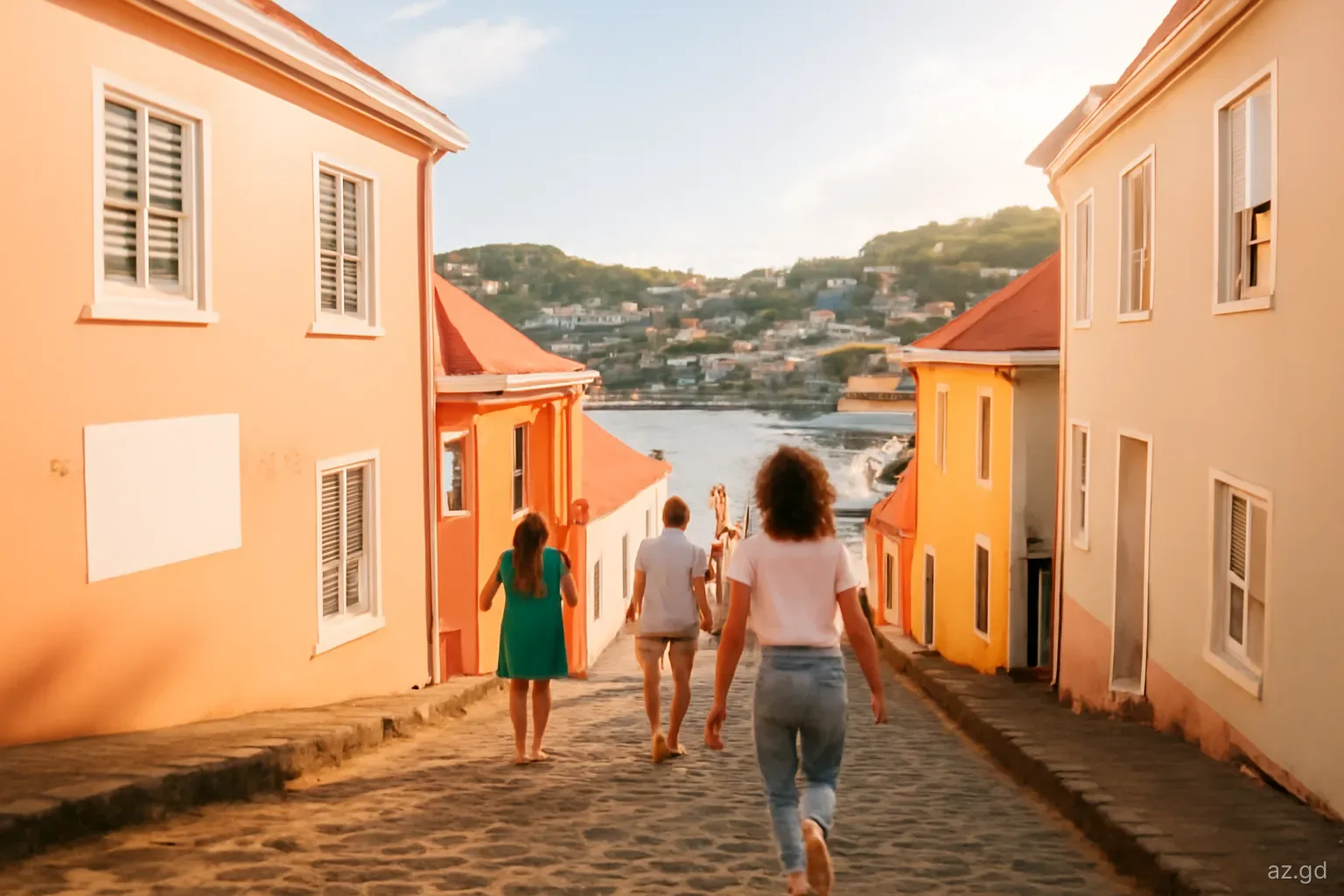
St George's is small enough to cross on foot in twenty minutes, yet first-time visitors regularly get lost in it. The town sits on a narrow volcanic ridge between two waterfronts, and the streets that connect them climb, twist and occasionally turn into flights of steps. Once the layout clicks, though, the capital is one of the most rewarding walks in the eastern Caribbean.
This orientation explains how the town fits together: the horseshoe harbour of the Carenage on one side, the Esplanade and Melville Street on the other, the ridge with Fort George and the churches in the middle, and Fort Frederick watching from the hills to the east. It covers the order to walk it in, what to expect on the way and the mistakes that make the day harder than it needs to be.
Everything described here is within a compact area of roughly one square kilometre, but distances on foot feel longer because of the gradients. The route below assumes average fitness and a willingness to climb; anyone with limited mobility can see most of it by taxi, with short walks at the flatter Carenage and Esplanade waterfronts.
Two waterfronts and a ridge
Think of St George's as a saddle. On the eastern side is the Carenage, the deep, sheltered inner harbour lined with warehouses, offices, restaurants and the ferry berth for Carriacou. On the western side is the open bay, where cruise ships tie up at the Melville Street terminal and the Esplanade runs along the sea. Between them rises a ridge crowned by Fort George.
The two sides are linked by the Sendall Tunnel, a short, narrow road tunnel cut through the ridge in the 1890s and named after the governor of the day, Walter Sendall. Cars, buses and pedestrians share it, and it is the quickest flat route between the Carenage and the market side of town. Walk with care and keep to one side; there is little room when a bus comes through.
Above the tunnel, the old town spreads across the slope: Church Street, Young Street, Granby Street, Halifax Street and their connecting lanes. This is where the cathedrals, the National Museum, government buildings, shops and Market Square are found. Most streets run either along the contour or straight up it, which is why a short distance can involve a stiff climb.
A sensible walking route
This loop takes two to three hours at an easy pace, longer with the museum and a meal. Start early; by late morning the stone streets hold a lot of heat.
- Begin on the Carenage, walking the waterfront from the inner harbour end. Watch boats being loaded for the sister islands and the fishing boats unloading on the far side.
- Climb Young Street to the Grenada National Museum, housed in old French barracks that later served as a prison; it has been closed for long periods since 2020, so check it has reopened. Its displays cover Amerindian artefacts, the colonial era and the twentieth century.
- Continue up to Church Street for the Roman Catholic Cathedral of the Immaculate Conception and, nearby, St George's Anglican Church, both rebuilt after severe damage from Hurricane Ivan in 2004.
- Follow the ridge west to Fort George, begun by the French in 1705. Much of it is still used by the police, so some areas are closed, but the ramparts give the best view over both harbours.
- Drop down through the lanes or the Sendall Tunnel to Market Square and Melville Street. Finish along the Esplanade, where the bus terminal makes it easy to head out of town.
Market Square and the shopping streets
Market Square. The historic heart of commerce, where vendors sell fruit, vegetables, spices, ground provisions and crafts. It is open through the week, but Saturday morning is the busiest and most lively time. Go early for the best produce.
Spice and craft stalls. Spice baskets, nutmeg products, cocoa balls and handmade items are sold around the square and near the cruise terminal. Prices on cruise days tend to be higher; compare a few stalls before buying.
The town shops. Halifax, Granby and Hillsborough streets hold hardware stores, pharmacies, clothing shops and banks. Locals do practical shopping here; the large supermarkets are mostly out at Grand Anse.
The Esplanade side. The Esplanade Mall and the cruise terminal area cater to ship passengers, with duty-free goods and souvenirs. Outside ship days this part of town is noticeably quieter.
Sundays. Almost everything closes on Sunday except churches, a few restaurants and some shops near the terminal. Plan town errands for weekdays or Saturday morning.
Fort Frederick and the hills to the east
Fort Frederick stands on Richmond Hill, east of the Carenage and above the inner harbour. Started by the French and finished by the British in the 1790s, it was built facing inland, because the French had captured the island in 1779 by attacking from the landward side. The view takes in the whole town, the south coast and, on a clear day, the hills of the interior.
Walking there from the Carenage is possible but involves a long uphill stretch along roads with little or no pavement. Most visitors take a taxi up and walk back down, which is easier on the legs and safer with traffic. Allow at least an hour for the round trip and the visit.
Nearby on the same ridge is Richmond Hill Prison and, slightly further, Mount Wheldale, where Grenada's Parliament now sits in a newer building. The older parliament complex at York House in town was badly damaged by Hurricane Ivan.
Mistakes that spoil a day in town
St George's is welcoming and generally easy to walk, but a few practical errors come up again and again.
- Underestimating the hills. Comfortable shoes with grip matter more than anything else. Some lanes are steep, uneven and slippery after rain.
- Walking at midday. The town is hot and reflective between about 11:00 and 15:00. Carry water and use the shade of church interiors and the museum.
- Forgetting the cruise calendar. When two or more ships are in, the Esplanade, tunnel and fort are crowded. Check which days ships are scheduled if a quiet visit matters.
- Standing in the road for photos. Streets are narrow, pavements disappear, and buses move quickly. Move into a doorway or onto steps before stopping.
- Relying on street names. Many locals give directions by landmarks — the market, the cathedral, the fire station — rather than street names. Ask with a landmark in mind.
Breaks, food and practical stops
Public toilets are limited in St George's, so plan breaks around places where you are a customer: cafes and restaurants on the Carenage, food spots near Market Square, and the museum. The Carenage is the easiest area for a sit-down lunch with a view over the boats, while the streets around the market have small local eateries serving rotis, stewed chicken, fish and fresh juices at lower prices.
Banks, pharmacies and supermarkets are spread through the central streets, and ATMs are available, though queues lengthen on Fridays and at month-end. Carry some Eastern Caribbean dollars in small notes for market stalls, snacks and minibus fares. Card payment is common in larger shops and restaurants but not with street vendors.
When you are ready to leave, the main bus terminal on the Melville Street side serves routes to Grand Anse and the south, as well as to the parishes. Taxis wait near the cruise terminal and along the Carenage; agree the fare before getting in, as most do not run a meter. On cruise days, demand for taxis peaks in the late afternoon as passengers return to their ships.
Frequently asked questions
How long does it take to walk around St George's?
The core of town can be seen in two to three hours, including the Carenage, the museum, the churches, Fort George and Market Square. Add an hour for Fort Frederick and extra time for lunch or shopping.
Is the Sendall Tunnel safe to walk through?
Pedestrians use it every day, but it is narrow and shared with buses and cars, with only a slim walkway. Keep to the edge, walk in single file and avoid stopping inside, especially during busy morning and afternoon traffic.
What day is Market Square busiest?
Saturday morning is the main market day, when farmers and vendors come in from the parishes and the square is at its fullest. Weekday mornings are calmer but still good for fruit, vegetables and spices.
Can you walk from the cruise terminal to the Carenage?
Yes. It is a short walk either through the Sendall Tunnel or over the ridge via the steep streets near Fort George. The tunnel route is flatter; the ridge route is more scenic but involves steps and climbs.
Is St George's open on Sundays?
Most shops, banks and government offices close on Sunday, and the town is very quiet apart from church services. A few restaurants and businesses near the cruise terminal may open, particularly when a ship is in port.