Grenada is divided into six parishes: St George, St David, St Andrew, St Patrick, St Mark and St John. Carriacou and Petite Martinique sit outside that system as a dependency administered together. Parish names turn up everywhere, from postal addresses and police districts to cricket rivalries and radio death announcements, so knowing roughly where each one lies makes the country far easier to read.
The differences are bigger than the small total area (about 344 square kilometres for the whole state) suggests. One parish holds more than a third of the population; another has fewer people than a mid-sized town abroad. The figures below come from the 2011 census, the most recent full count widely published, and should be treated as indicative rather than current.
The six parishes at a glance
Each parish has a seat, usually its largest town, with the exception of St David. Populations are 2011 census figures, rounded; areas are approximate.
- St George (seat: St George's) — about 65 km² and roughly 38,000 people. The capital, the airport, St George's University, Grand Anse and most hotels and offices.
- St Andrew (seat: Grenville) — the largest parish at about 99 km², with around 26,500 people. Agricultural heartland of the windward (Atlantic) side.
- St David (no official town; the village of St David's is the main settlement) — about 44 km², close to 13,000 people. South-east coast of bays and headlands.
- St Patrick (seat: Sauteurs) — about 42 km², around 10,500 people. The northern tip, with estates, crater lakes and Atlantic beaches.
- St John (seat: Gouyave) — about 35 km², around 8,500 people. A fishing and nutmeg parish on the leeward (Caribbean) coast.
- St Mark (seat: Victoria) — the smallest, at about 25 km² and roughly 4,400 people. Steep, quiet and green, below Mount St Catherine.
Leeward, windward and the mountain in between
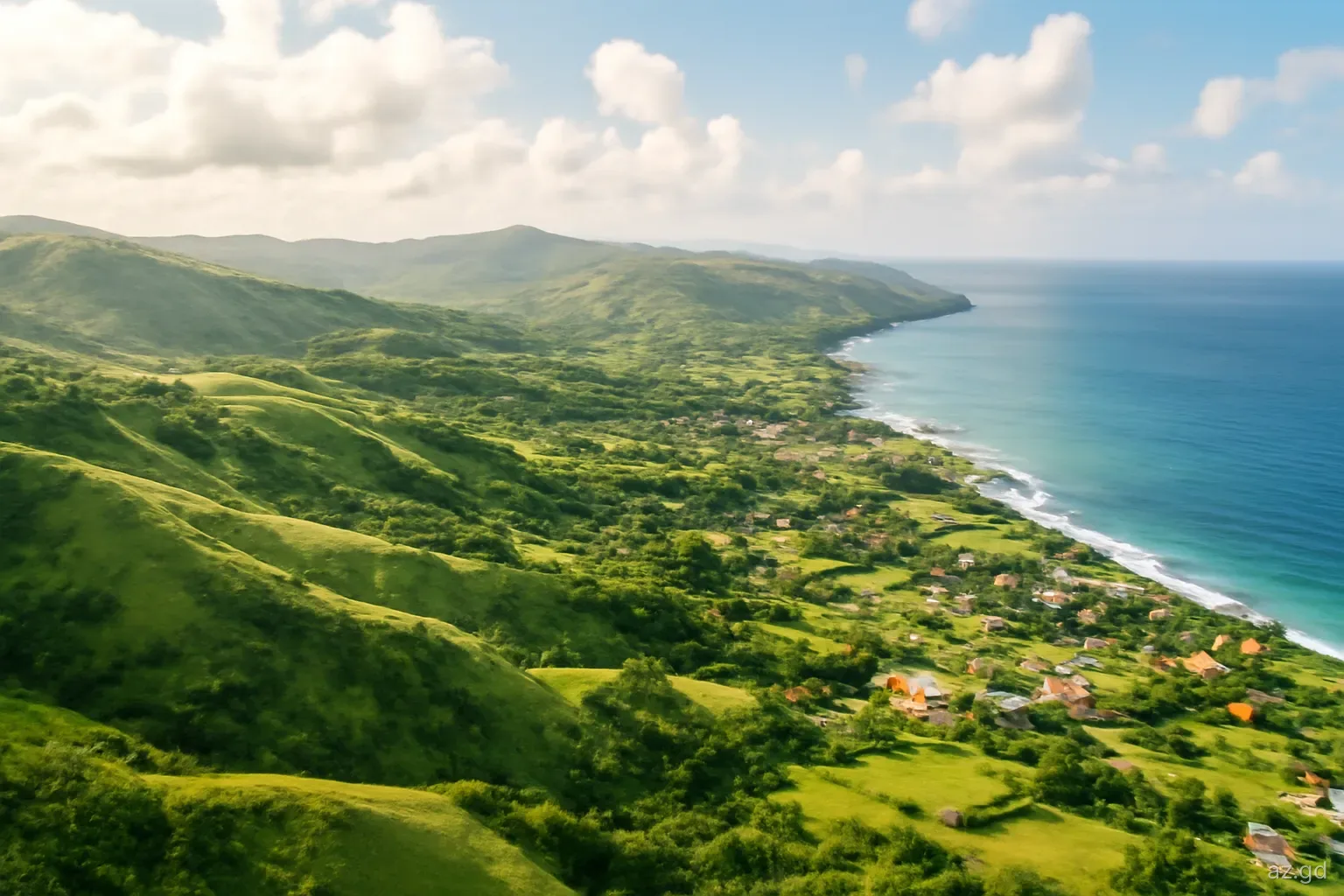
The quickest way to picture the parishes is to imagine the island's spine. A chain of forested ridges runs roughly north to south, with Mount St Catherine (about 840 metres) at its northern end and Grand Etang near the middle. West of the ridges is the leeward coast: calmer sea, a narrow strip of flat land, and the string of fishing towns from St George's up through Gouyave and Victoria to Sauteurs. East of the ridges is the windward coast, facing the Atlantic trade winds, with broader valleys, more farmland and rougher water.
St George and St David share the south, where the coast breaks into long fingers of land and sheltered bays. That geography is why yachts, marinas and much of the newer housing are concentrated there. St Andrew fills most of the eastern side, St Patrick caps the north, and St John and St Mark are wedged between the mountains and the Caribbean Sea on the west.
Rainfall follows the same pattern. The interior and the windward slopes are noticeably wetter than the south-western tip around Point Salines, which can turn brown and dry by April. Choosing a parish for a long stay is partly choosing a microclimate.
What daily life feels like in each parish
St George. Traffic, commerce and services. Most government ministries, banks, the main hospital and the large supermarkets are here, along with suburbs such as Grand Anse, Morne Jaloux, True Blue and Lance aux Epines. Expect the highest rents and the most choice.
St Andrew. Farming, schools and a busy regional town. Grenville has its own market, bus terminal, courts and secondary schools, so many St Andrew residents rarely need to travel to the capital for everyday errands.
St David. Residential and scattered, with no single centre. Villages such as Westerhall, La Tante, Corinth and Pomme Rose line the roads, and people shop either in the south of St George or in Grenville.
St Patrick. Rural, close-knit and agricultural, with Sauteurs as its market town. Estates, rum and the northern beaches draw day visitors, but the parish empties out after dark.
St John. Built around the sea and the nutmeg trade. Gouyave's fishing fleet and weekly Fish Friday give it a stronger evening life than its size would suggest.
St Mark. The quietest parish: one coastal road, steep hillside villages and Victoria as a small service town. Many residents commute south for work.
Carriacou and Petite Martinique: not a seventh parish
People often count Carriacou as a parish, but officially Carriacou and Petite Martinique form a dependency of Grenada, administered together, with Hillsborough as the main town. The 2011 census recorded a little under 6,000 people on Carriacou, and Petite Martinique has long been put at around 900. Both islands were badly damaged when Hurricane Beryl made landfall on 1 July 2024, and rebuilding has continued since.
In practice the sister islands have their own ministry, their own hospital (Princess Royal Hospital at Belair), their own festivals and a distinct culture, including the Big Drum tradition and an older pre-Lenten Carnival. Addresses there are written as the village name followed by Carriacou or Petite Martinique, not by a parish.
Politically, Carriacou and Petite Martinique form one of Grenada's 15 parliamentary constituencies. The mainland's other 14 are drawn inside the six parishes: St George has five, counting the Town of St George; St Andrew has four; St Patrick has two; and St David, St John and St Mark have one each.
Common mix-ups to avoid
Most confusion comes from the same few names being used for different things. Check which meaning is intended before you book, post a parcel or give directions.
- St George's versus St George. St George's (with the apostrophe) is the capital town; St George is the whole parish. An address in Grand Anse or True Blue is in St George but not in St George's.
- Church parishes. Anglican and Catholic parishes do not always match civil boundaries, so a church notice may use a different area name.
- Few street numbers. Outside town centres, addresses are usually a village plus parish, and deliveries rely on landmarks. Give drivers a nearby church, school or shop.
- Leeward does not mean west everywhere. Locals use leeward and windward loosely. On the south coast, the distinction is about shelter rather than compass direction.
- Old census figures. Population numbers quoted online are often from 2011 or earlier. For current data, check with the Central Statistical Office.
How parishes work in practice today
Grenada has no elected parish councils. Services are run by central government ministries based in St George's, which then operate through local offices: district health centres and medical stations, police stations grouped into divisions, post offices, magistrates' courts in the larger towns, and offices of the agencies that deal with water, roads and agriculture. So when people talk about the parish, they usually mean a community and a geography rather than a level of government.
Parish identity is still strong. Sports leagues, school rivalries, church festivals and the annual round of community events are organised along parish lines. St John has Fish Friday and Fisherman's Birthday in Gouyave, St Patrick has its March fiesta in Sauteurs, and St Andrew has the Rainbow City Festival in Grenville, while national events such as Spicemas pull everyone into St George's in August.
For newcomers, the parish matters most for logistics: which health centre serves you, which police station handles a report, which magistrate's court deals with a local matter, and how long the commute will be. When renting or buying, ask which of these local services are nearest, not just how far the beach is.
Frequently asked questions
How many parishes does Grenada have?
Grenada has six parishes on the main island: St George, St Andrew, St David, St Patrick, St John and St Mark. Carriacou and Petite Martinique are a dependency administered together rather than a parish, although many people informally call it the seventh.
Which is the largest parish in Grenada?
St Andrew is the largest by area, at roughly 99 square kilometres on the Atlantic side. St George has the most people, because it contains the capital, the airport, the university and the main hotel strip around Grand Anse.
Which parish is St George's University in?
St George's University is at True Blue in the parish of St George, near Grand Anse and the airport. It is a few kilometres south of the town of St George's, so do not confuse the university's location with the capital itself.
Does St David have a capital town?
St David has no town comparable to Grenville or Gouyave. The village of St David's, between La Tante and Westerhall, is usually treated as its main settlement, and residents use shops and services in southern St George or Grenville.
Which parish is best for a long stay?
It depends on priorities. St George offers services, shops and the widest choice of rentals; St David gives quieter bays within commuting distance; St Andrew, St Patrick, St John and St Mark suit people who want rural life and do not mind longer drives.
Are the parishes used in postal addresses?
Yes. A typical address is a name, a village or district, and the parish, for example a house in Morne Jaloux, St George. Adding a landmark helps, because most rural roads have no house numbers.