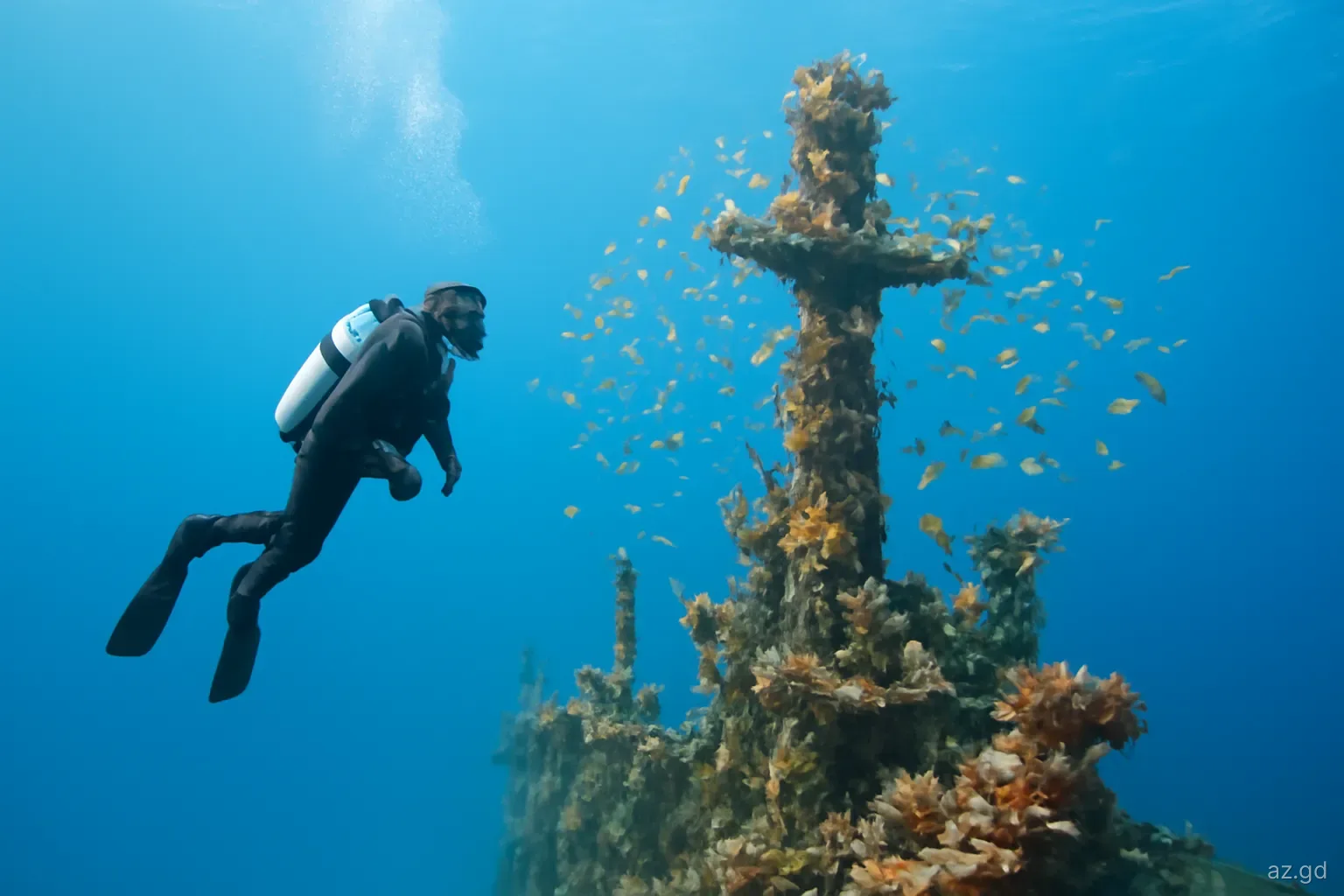
Grenada calls itself a wreck-diving capital of the Caribbean, and the claim rests on more than one famous liner. Around the south and west coasts lie freighters, a converted wartime minesweeper and ships sunk on purpose as reefs, ranging from an easy 15-metre wreck that new divers visit on day one to deep Atlantic-side wrecks swept by current that challenge experienced divers.
This page orders the main wrecks roughly by difficulty, with what each one offers and what it demands. Depths are approximate, and published figures differ by a few metres; your guide's briefing is the figure that counts. Grenada's Atlantic-side wrecks in particular depend on weather, so treat any plan to dive them as provisional.
The wrecks, roughly in order of difficulty
Each step up the list adds depth, current or both. Most divers work their way up over a trip rather than jumping straight to the deep end.
- Veronica L, about 15 metres. A small freighter that sank after a leak, was raised and then moved off Grand Anse to make way for the cruise terminal in St George's. She sits upright on sand, heavily grown with soft corals and sponges, with seahorses, moray eels and the occasional turtle. Suitable for Open Water divers and good at night.
- Buccaneer, about 24 metres. A steel sloop sunk as an artificial reef in 1978, lying on her starboard side and thickly encrusted after decades on the bottom. A compact wreck that suits divers moving from reefs to wrecks.
- Shakem, about 30–32 metres. A cargo ship of about 50 metres carrying cement that sank upright in 2001 when her load shifted in a storm. The bags of hardened cement are still in the hold, and the amidships crane is covered in sea fans and sponges. Advanced level, usually calm.
- Hildur, about 35 metres. A cargo vessel sunk in Grand Mal Bay north of St George's in 2007, now gathering schools of spadefish and barracuda above her. Experienced divers only.
- Hema 1, about 30 metres, often in current. A cement carrier that sank in 2005 while returning empty to Trinidad, a few miles off the south coast, later broken apart by storm surge. Nurse and reef sharks are regular visitors.
- King Mitch, about 32 metres, Atlantic side. A Second World War minesweeper converted to a freighter, lying on her side several miles off the south-east coast since 1981. Strong current and open-ocean conditions; known for nurse sharks, southern stingrays, barracuda and amberjacks.
- Persia II, about 35 metres. A cargo ship that sank in 2017 about eight miles offshore near deep water, one of the newest wrecks in the area, quickly colonised by reef fish.
Caribbean side versus Atlantic side
The wrecks off Grand Anse and the west coast lie in the lee of the island. Seas are usually calm, boat rides are short, and growth on the wrecks is dense because the water is sheltered and rich. The Veronica L, the Shakem and the Bianca C are all in this zone, which is why they are dived most often.
The south-east and Atlantic-side wrecks are a different proposition. The trade winds blow across the Atlantic onto this coast for most of the year, building swell and pushing currents that run strongly over the wrecks. Visibility is often superb because of the open-ocean water, but entries and exits are harder, boat rides longer and the window for diving narrower. Operators on the south coast run these trips when the weather allows and when they have a group of suitably experienced divers.
The practical effect is that you cannot book the King Mitch or the Hema 1 for a fixed date weeks in advance. Tell your operator early in the trip that you want them, and be ready to go when conditions line up.
What operators expect for the deeper wrecks
Advanced certification and a deep rating. Every wreck from the Shakem downwards sits at or beyond 30 metres. Expect to show at least Advanced Open Water and, for the deepest, a deep specialty or equivalent experience.
Comfort in current. Negative or fast descents are common on the current-swept wrecks so the group reaches the hull together rather than being carried past it. If you have not done one before, practise on a calmer site first.
A surface marker buoy you can deploy. Drift ascents in open water are standard. Each diver or buddy pair is often asked to carry and deploy their own marker so the boat can track them.
No penetration unless trained. Some of these ships have intact interior spaces, but entering them needs wreck-penetration training, a line and the right gas planning. Recreational dives stay outside or in open, well-lit sections such as cargo holds.
Nitrox certification helps. Enriched air extends no-decompression time at around 30 metres, which matters on wrecks where bottom time is otherwise very short.
Life on the wrecks
Sunken steel in warm water becomes reef surprisingly fast. Within a few years of sinking, hulls are coated in encrusting sponges, hydroids and soft corals, and the structure gives shelter to animals that would have nowhere to hide on open sand. That is why even small wrecks like the Veronica L hold more life per square metre than much of the surrounding seabed.
Typical residents include moray eels in the gaps between plates, lobsters under ledges, squirrelfish and glasseye snappers in shaded corners, and schools of grunts and snapper over the decks. Larger visitors arrive from the blue: barracuda hanging above the masts, Atlantic spadefish, jacks and amberjacks, spotted eagle rays, and nurse sharks resting on the sand beside the hull. Seahorses and frogfish are found by divers with patient eyes and good guides.
Lionfish, an invasive Indo-Pacific species, colonise wrecks quickly. Some operators cull them under permit; visiting divers should not try, since the venomous spines cause painful injuries.
Mistakes divers make on Grenada's wrecks
Wreck diving off Grenada is generally safe with a competent operator. Problems tend to follow a familiar pattern.
- Booking several deep wrecks on consecutive days without building up to them, which stacks nitrogen and fatigue.
- Touching the hull and fittings: the growth is fragile, and rusting steel edges cut. Gloves are discouraged in many places for this reason.
- Drifting off the wreck in current without telling a buddy, then surfacing far from the boat without a marker.
- Chasing a photo into a hold or under a collapsed section where silt can drop visibility to zero.
- Treating published depths as exact. Sand shifts, structures collapse and a deck that was 28 metres years ago may now be deeper.
- Forgetting the flight home. Several deep dives over a few days need a long gap before flying, ideally a full day or more.
Building a wreck itinerary for a week
A sensible week for an experienced diver might start with a reef and the Veronica L to check weighting and settle in, add the Shakem or the Buccaneer the next day, then the Bianca C mid-week once the operator has seen you dive. Atlantic-side wrecks slot in whenever the weather allows, and the last day before flying is kept for shallow reef or no diving at all.
Divers with less experience can make the same week work by taking Advanced Open Water in the first days, with the deep and wreck adventure dives done on the Veronica L and the Shakem. Many operators sell packages that mix wrecks and reefs; ask which wrecks are realistically included rather than assuming the brochure list is guaranteed.
Frequently asked questions
How many wrecks can you dive in Grenada?
Around a dozen are regularly visited, with more in deeper water or rarely dived. The core list for most visitors is the Bianca C, the Veronica L, the Shakem, the Buccaneer, the Hema 1, the King Mitch, the Hildur and the Persia II, plus the Twin Tugs off Carriacou.
Which wreck is best for a first wreck dive?
The Veronica L. At about 15 metres off Grand Anse she is within Open Water limits, sits upright, is usually calm and is covered in marine life. Many operators use her as a checkout dive before taking divers to deeper wrecks.
Are the Atlantic-side wrecks worth the effort?
For experienced divers, yes. The King Mitch and the Hema 1 often have outstanding visibility and draw sharks and rays. But they demand comfort in current and a flexible schedule, since rough seas regularly cancel the trips.
Do you need a wreck specialty certification?
Not to dive around the outside of a wreck at a depth your certification allows. A wreck specialty teaches safe technique and limited penetration, and some operators prefer it for the deeper wrecks. It is a popular course to take in Grenada for that reason.
Is there current on the Shakem?
Usually less than on the Atlantic-side wrecks. The Shakem lies off the sheltered west coast and is often calm, which makes it a good step between the Veronica L and the Bianca C. Conditions still vary, so follow the guide's briefing on the day.