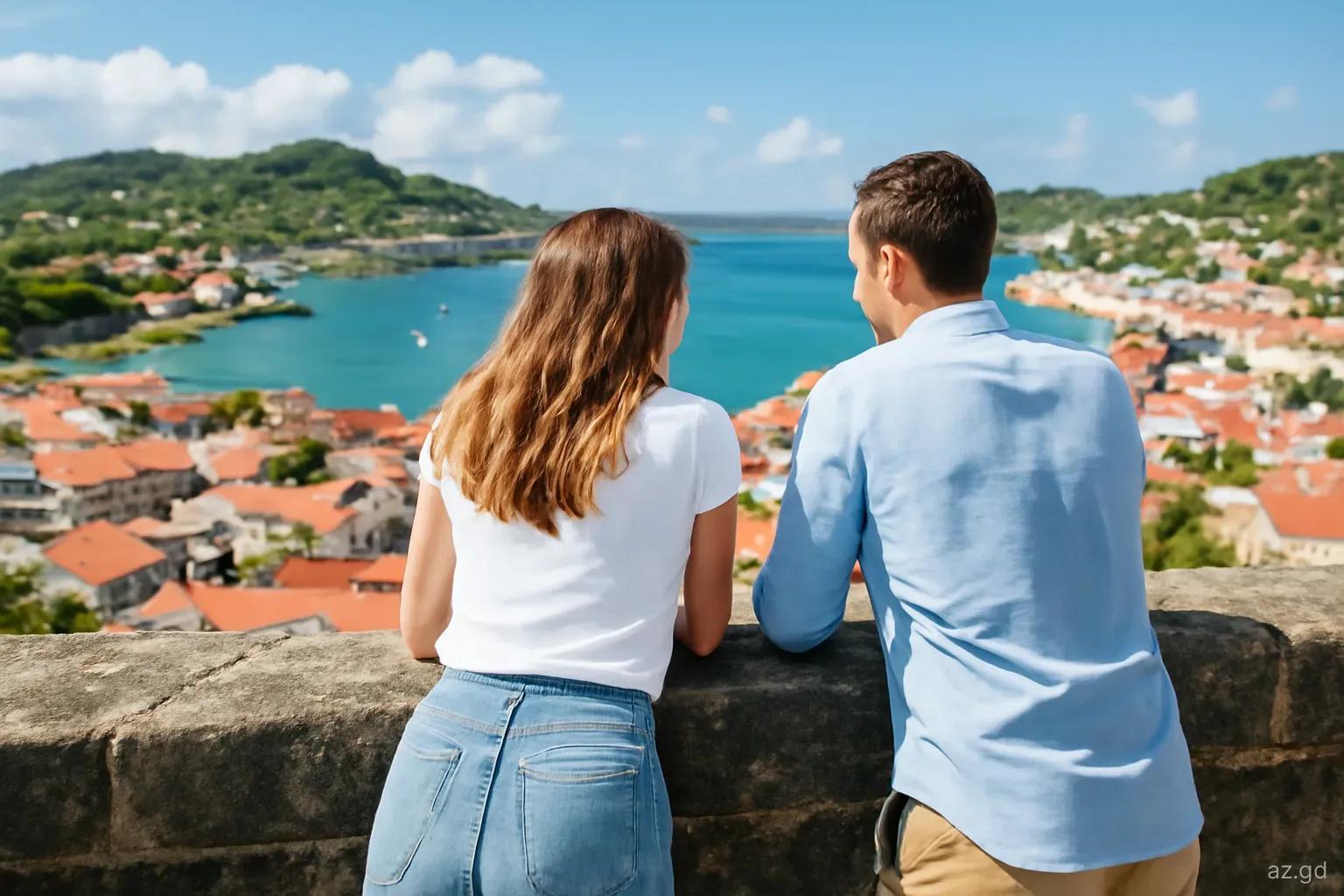
Fort George sits on the headland that separates the Carenage, St George's sheltered inner harbour, from the open sea. From its walls you look down on the horseshoe of red roofs and warehouses around the harbour, across to the cruise terminal on one side and along the coast towards Grand Anse on the other. It is the oldest surviving fortification on the island and the one most tied to Grenada's modern history.
For decades the fort was hard to appreciate because it was the working headquarters of the Royal Grenada Police Force. The police moved out in 2024, and the government has announced plans to redevelop it as a heritage attraction. This guide covers what the fort is, what happened there, and what a visitor can realistically expect while that work continues.
Three centuries in three names
The French built the fort between 1706 and 1710 on a site where an artillery battery had already stood, and called it Fort Royal. Its job was simple: command the harbour entrance and protect the young town and its shipping from British and Dutch raiders. The design follows the European bastion style of the period, with thick masonry walls angled to give defenders overlapping fields of fire.
When Britain took Grenada in 1762 and kept it under the Treaty of Paris of 1763, Fort Royal became Fort George, after the new king, George III. Through the eighteenth and nineteenth centuries it served as part of a defensive system that later included the hilltop forts on Richmond Hill. After the 1979 revolution the People's Revolutionary Government renamed it Fort Rupert, in honour of Maurice Bishop's father, Rupert Bishop, killed in St George's in January 1974. The name Fort George returned after 1983.
The fort is one of the components of the St George Fortified System, which Grenada has placed on UNESCO's World Heritage Tentative List, the first step towards a possible nomination.
19 October 1983: the execution site
The fort's most painful chapter came on 19 October 1983. A large crowd freed Prime Minister Maurice Bishop from house arrest and went with him to Fort Rupert, which they occupied. Soldiers sent from Fort Frederick retook it that afternoon. Bishop and seven others, including the ministers Jacqueline Creft and Unison Whiteman, were executed by firing squad in the courtyard. Others died in the gunfire or jumping from the walls to escape. Six days later, US and Caribbean forces landed.
A plaque installed in 1993 marks the spot, and in 2024 the government committed to building a permanent memorial there. Memorial services are held at or near the fort each October. Treat the courtyard as you would any place where people were killed within living memory: quiet voices, no posed photographs at the plaque, and respect for anyone visiting to remember a relative.
What you can see
The walls and bastions. The main reason to come. The ramparts give some of the best views of St George's, especially of the Carenage, the hills behind town and the coast to the south.
Cannon. Colonial-era guns remain on the walls, though not mounted as they would have been in service.
Underground rooms and tunnel. The fort has vaulted chambers and a historic tunnel. Redevelopment plans announced in 2023 included restoring the tunnel and adding a museum and a restaurant; check what has been completed and what is open.
The harbour mouth. From the seaward walls you see why the French chose this spot: every ship entering the Carenage had to pass beneath the guns at close range, and the deep channel still carries yachts, ferries and fishing boats past the headland today.
The setting. The General Hospital stands immediately next to the fort, and its rebuilding after a fire changed views towards the headland. Expect construction activity nearby.
Getting there and visiting
The fort is a short, steep walk from the centre of St George's. There is no dedicated visitor parking in the old town, so walking is easiest.
- Start on the Carenage or at Market Square. From the Carenage, follow Young Street uphill past the National Museum, then turn towards the headland and the hospital; from the Esplanade side, Church Street leads up the hill.
- Allow about ten to fifteen minutes on foot from the Carenage. The streets are steep and pavements narrow, so wear shoes with grip and carry water in the midday heat.
- Check access before you go. With the police gone and redevelopment under way, opening times and entry arrangements may change. Ask at your hotel, the cruise terminal information desk or the Grenada Tourism Authority.
- If an entrance fee applies, it has historically been small; carry some EC dollars in cash in small notes.
- Combine the visit with the National Museum (check it has reopened; it has been closed for long periods since 2020), the Anglican and Catholic churches on Church Street and the Sendall Tunnel, all within a few minutes' walk. Fort Frederick on Richmond Hill is best reached by taxi.
Photography and timing tips
The light at Fort George changes the experience. Early morning sun lights the Carenage and the hillside houses from the east, which suits photographs looking back over the harbour. Late afternoon puts the sun behind the headland for views out to sea, and on clear evenings the sky over the Caribbean turns orange and pink. Midday is harsh, hot and crowded on cruise days.
Drones are a separate matter. Grenada regulates drone use through the Eastern Caribbean Civil Aviation Authority and local police, and flying near the hospital, government buildings or crowds is a bad idea even where it is technically possible. If you want aerial shots, seek permission in advance through the proper channels. On the ground, a wide-angle lens or phone setting captures the sweep of the Carenage from the ramparts; a short zoom picks out the church towers on the ridge and the boats below.
Mistakes to avoid
A few things catch visitors out at Fort George:
- Confusing it with Fort Frederick. Fort George is the harbour fort in town. Fort Frederick is the larger hilltop fort on Richmond Hill, a short taxi ride inland.
- Assuming it is a polished museum. For most of its recent history the fort was a police compound. Facilities are basic while redevelopment proceeds.
- Arriving on a busy cruise day at midday. St George's fills up when several ships are in. Go early in the morning or later in the afternoon for cooler air and fewer people.
- Photographing people at the memorial. October visitors are often relatives. Ask before including anyone in a photograph.
- Wandering into restricted areas. Building works and the neighbouring hospital have their own boundaries; follow signs and staff directions.
Why the fort matters beyond the view
Many Caribbean capitals have an old harbour fort. Fort George is unusual because it compresses so much of one country's story into a small space: the French founding of the town, the Anglo-French wars, the long colonial era when it was a garrison and then a police base, and the events of 1983 that still divide and grieve Grenadians. Few heritage sites in the region carry such recent memory alongside such old stone.
That is also why its redevelopment has attracted debate. Some want a lively attraction with a restaurant and exhibitions; others argue the execution site should stay a place of reflection first. A visit now catches the fort in transition, and it is worth reading a little of the 1983 history beforehand so the courtyard means more than a photo stop.
Frequently asked questions
When was Fort George in Grenada built?
The French built it between 1706 and 1710 and named it Fort Royal. The British renamed it Fort George after taking the island in 1762 to 1763. It was called Fort Rupert from 1979 to 1983.
Is Fort George still the police headquarters?
No. The Royal Grenada Police Force moved its headquarters out in 2024 to a building on the Carenage, opened in March 2025. The fort is being redeveloped as a heritage and tourism site.
Is Fort George open to visitors?
Visitors have been able to walk onto the ramparts, but arrangements may change during redevelopment. Check current access and any fee with the Grenada Tourism Authority, your hotel or the cruise terminal information desk.
What happened at Fort George in 1983?
On 19 October 1983 Prime Minister Maurice Bishop and seven others were executed in the courtyard, then called Fort Rupert, after a split in the ruling party. A plaque marks the site, and memorial services are held each October.
How long does a visit to Fort George take?
Around 30 to 45 minutes for the walls, views and memorial plaque. Add time if exhibitions or the restored tunnel are open. It combines easily with the churches nearby and the National Museum, if it has reopened.
Can you walk to Fort George from the cruise terminal?
Yes. It is a steep walk of roughly fifteen to twenty minutes through the old town. Wear comfortable shoes, carry water, and avoid the hottest part of the day if you can.