Grenada's nickname, the Spice Isle, rests largely on one tree. Nutmeg has been grown here since the nineteenth century, it appears on the national flag, and for decades Grenada was one of the world's two leading producers alongside Indonesia. The tree also produces a second spice from the same fruit: mace, the lacy red covering wrapped around the seed.
Most visitors meet nutmeg as a dusting on a rum punch or a souvenir in a spice basket. Understanding how it grows, how farmers handle it and what each part is used for makes a visit to a processing station, an estate or Market Square far more interesting, and helps when buying spice to take home.
This guide explains the fruit and its parts, how the tree grows, how harvesting works, the history and the hurricane years, the products made from nutmeg, and what to check when buying and using it.
One fruit, two spices
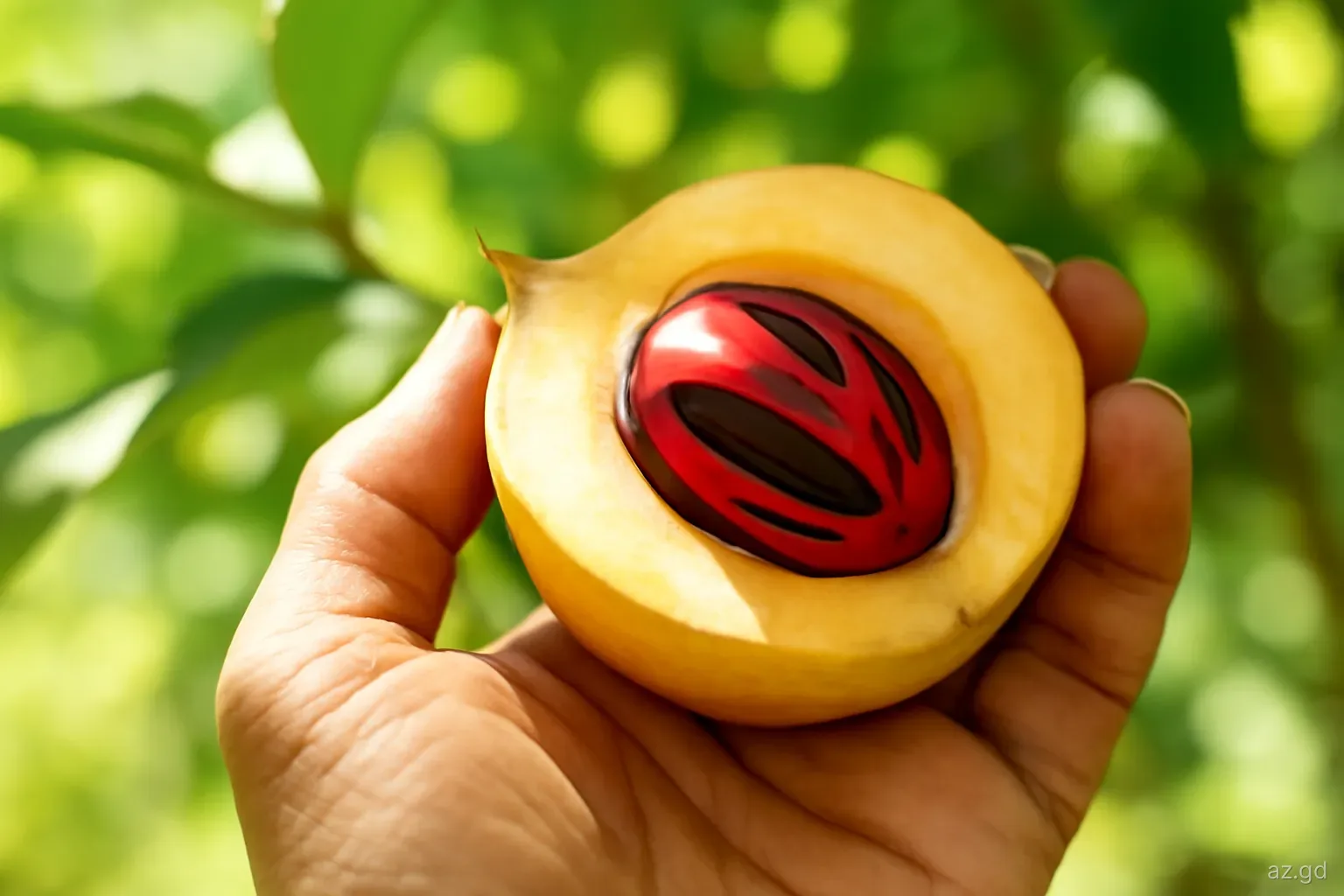
The fruit. Nutmeg grows as a pale yellow, apricot-sized fruit. When ripe it splits open along a seam, revealing what is inside. The fleshy outer layer, the pericarp, is tart and astringent and is not the spice itself.
The mace. Wrapped around the seed is a bright crimson, net-like covering called the aril. This is mace. It is peeled off by hand, flattened and dried, turning from scarlet to orange-red or golden as it dries.
The shell. Under the mace is a hard, glossy, dark brown shell. Nutmegs are dried in this shell, which is later cracked.
The nutmeg. Inside the shell is the kernel: the nutmeg as sold in shops, oval, wrinkled and highly aromatic. It is grated or ground for use.
Two flavours. Nutmeg is warm, sweet and slightly woody. Mace is more delicate, peppery and floral, and is used where a subtler spice is wanted. Both come from the same fruit but are sold, priced and used separately.
How the tree grows
The nutmeg tree, Myristica fragrans, is an evergreen originally from the Banda Islands in what is now Indonesia. It likes deep, well-drained soil, high rainfall and some shelter, which the hills of St Andrew, St John, St Mark and St Patrick provide. Trees are often grown in mixed plantings with cocoa, bananas, fruit trees and other spices rather than in neat monocultures.
Nutmeg trees are usually either male or female, and only female trees bear fruit. Farmers cannot easily tell which a seedling will be until it flowers, often after several years, which has long made planting a gamble. Grafting and selected planting material help reduce this uncertainty. A young tree typically takes around four to six years or more to start bearing, and longer to reach full production, but a healthy tree can keep producing for decades.
The tree's shallow roots make it vulnerable to strong winds. That weakness shaped the recent history of the industry more than any market price.
How nutmeg is harvested and handled on the farm
Harvesting is mostly simple, manual work, and nutmeg is picked through much of the year rather than in one short season:
- Ripe fruits split on the tree and the nutmeg, with its mace, falls to the ground. Farmers collect fallen nuts regularly, and use long poles with a hook or basket to reach ripe fruit still on the branches.
- The pericarp is discarded in the field or collected for jam and jelly makers.
- The mace is carefully peeled from each seed by hand, keeping the pieces, called blades, as whole as possible. It is flattened and laid out to dry.
- The nutmegs in their shells and the dried or fresh mace are taken to a receiving station of the Grenada Cooperative Nutmeg Association (GCNA), where they are weighed and the farmer is paid.
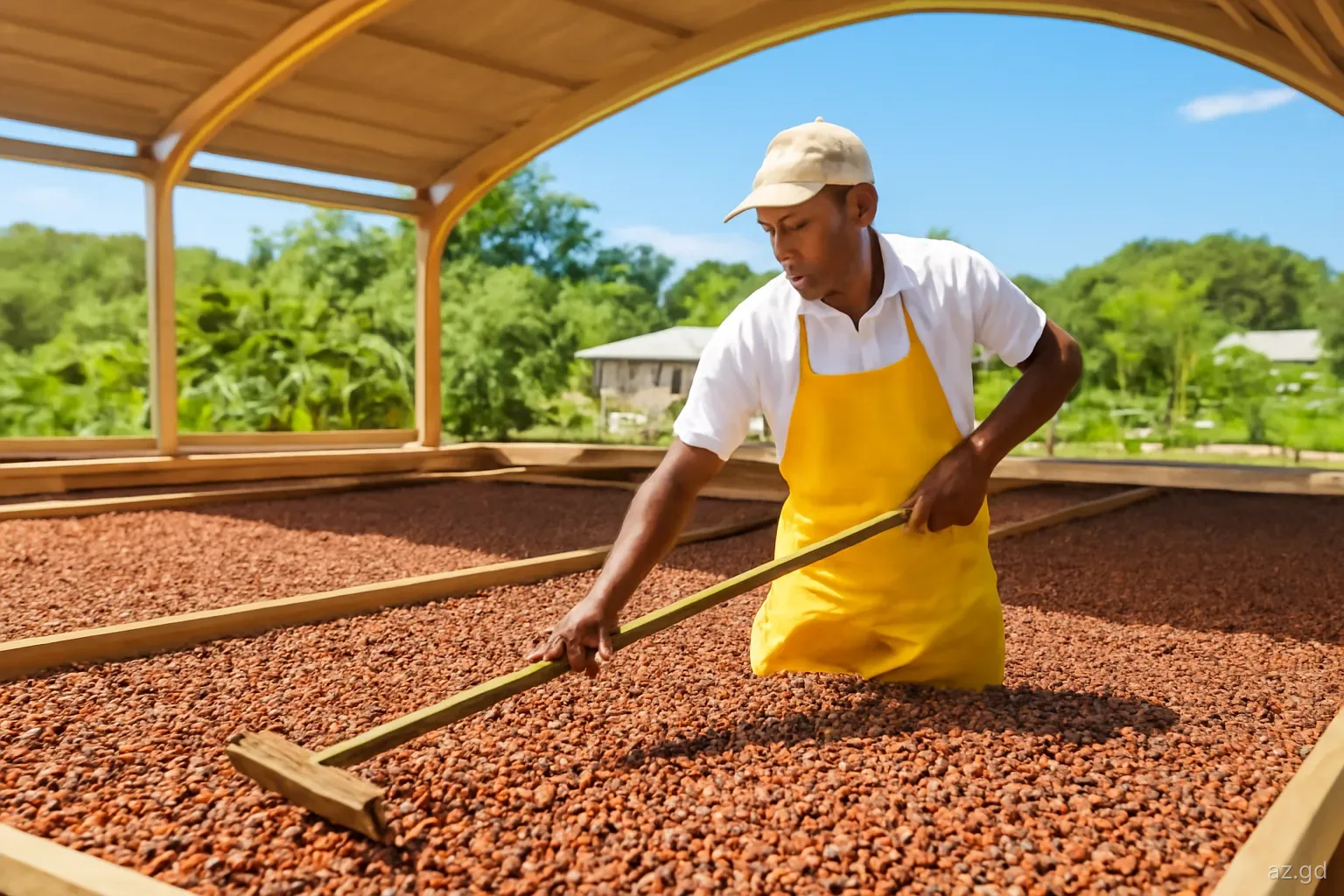
- At the processing station the nutmegs are dried for weeks, cracked, sorted, graded and bagged for export, while the mace is dried, cured and graded separately.
Nutmeg on the flag, and the hurricane years
Nutmeg was introduced to Grenada in the 1840s and became one of the island's most valuable exports. Its importance is reflected on the national flag adopted at independence in 1974, which shows a nutmeg on the red-bordered green triangle near the hoist. The GCNA, set up in the 1940s, has organised the purchase, processing and export of the crop on behalf of farmers for most of the period since.
In September 2004, Hurricane Ivan devastated the industry. Official estimates suggest it destroyed around 70 per cent of the island's roughly half a million nutmeg trees, and Hurricane Emily in 2005 added further damage. Production fell to a fraction of earlier levels, processing capacity was cut, and many farmers left the crop. Replanting began soon after, but new trees take years to bear, and output has not returned to pre-Ivan levels.
Today nutmeg remains a symbol of national identity and an important source of income for many rural families, even though cocoa, tourism and other sectors now matter more to the economy.
What Grenadians make from nutmeg
Very little of the fruit is wasted. Beyond the grated spice, look for these products at markets, estates and supermarkets:
- Nutmeg jam, jelly and syrup. Made from the tart pericarp, with a distinctive sweet, slightly resinous flavour. Nutmeg syrup is used on pancakes and in drinks.
- Pain relief rubs and sprays. Nutmeg oil is used in locally made products for aches and sprains. These are sold widely in pharmacies and shops.
- Ground nutmeg and whole nuts. Sold in small bags and jars; whole nuts in the shell keep their aroma longest.
- Mace blades and ground mace. Used in cakes, soups, sauces and meat dishes.
- Candied nutmeg pieces. Sugared slices of the pericarp, eaten as a sweet.
- Nutmeg in food and drink. Grated over rum punch, eggnog and cocoa tea, and used in ice cream, sweet bread, cakes and savoury dishes.
How Grenadian cooks actually use it
Outside the export trade, nutmeg is an everyday seasoning in Grenadian homes, used more freely than in most European or North American kitchens. It is grated into macaroni pie and the white sauce of baked dishes, into cake batter and sweet bread, into porridges made from cornmeal, oats or green banana, and into punches and eggnog at Christmas. A grating goes into cocoa tea with cinnamon and bay leaf, and a little is often added to stewed fruit and to fruit juices such as golden apple and soursop.
Mace is used more sparingly, in soups, pickles, fish dishes and some cakes, where a softer perfume is wanted. Many households keep a whole nutmeg and a small grater next to the stove rather than a jar of ground spice.
For visitors, the simplest way to taste the difference fresh nutmeg makes is to grate a little over a fruit juice, porridge or ice cream: the aroma is noticeably stronger and sweeter than the faded ground spice many people are used to at home.
Buying, storing and using nutmeg safely
A few practical points help get the most from Grenadian nutmeg:
- Buy whole. Whole nutmegs keep their aroma for a year or more if stored dry and sealed. Ground nutmeg fades within months.
- Grate as needed. A small fine grater gives far better flavour than pre-ground spice.
- Check for holes. Tiny holes in the kernel can indicate insect damage. Good nutmegs are heavy and solid.
- Judge mace by colour. Good mace is bright orange-red to golden and aromatic. Dull brown, crumbly mace is old or poorly stored.
- Use small amounts. Nutmeg contains myristicin, which in large amounts, more than a couple of teaspoons at once, can cause nausea, dizziness and other unpleasant effects. Normal culinary use is safe.
- Keep it away from pets. Nutmeg can be toxic to dogs and cats in quantity.
Frequently asked questions
What is the difference between nutmeg and mace?
Both come from the same fruit. Mace is the red, lacy covering around the seed, peeled off and dried. Nutmeg is the kernel inside the seed's hard shell. Mace has a lighter, more floral and peppery flavour, while nutmeg is warmer and sweeter.
Why is there a nutmeg on Grenada's flag?
The nutmeg represents the country's identity as the Spice Isle and the historical importance of nutmeg to the economy. It appears on the green triangle near the hoist of the flag adopted at independence in 1974.
When is nutmeg harvested in Grenada?
Nutmeg trees bear fruit through much of the year, so harvesting is continuous rather than limited to one short season. Farmers collect fallen nuts regularly and deliver them, along with mace, to GCNA receiving stations around the island.
Did Hurricane Ivan destroy Grenada's nutmeg industry?
Ivan in 2004 destroyed a large share of the island's nutmeg trees, with official estimates around 70 per cent, and Emily in 2005 caused more damage. The industry survived and trees were replanted, but production has not returned to the levels seen before the hurricanes.
Is nutmeg dangerous?
Not in normal cooking quantities. Nutmeg contains myristicin, and eating large amounts, more than a couple of teaspoons at once, can cause nausea, dizziness and hallucinations. Keep whole nuts away from children and pets, and use nutmeg as a seasoning rather than in large doses.